Showing posts with label Guest post. Show all posts

Sunday, May 12, 2013

Guest post - First play of Factory Fun....


We played this last night. It's a game of machine building, input and output power sources, and pipe laying. Vaguely reminiscent of the old school Waterworks, only way more technical. It doesn't sound like a lot of fun, and it definitely isn't one of the prettier board games I've seen, so I wasn't sure what to think.  I don't know if it was the "post-birthday" sugar coma or the after effects of a house full of shrieking 5-year-old girls... but this one was a bumbling, brain fogging, head scratcher!  

It took us about 90 minutes to play from set-up to completion. Two of us have never played it before so the initial rules and strategy explanation was slow and overwhelming.  My husband caught onto the concept quicker than I, although he hit a major stumbling block when he cleared his factory floor completely and then couldn't reassemble all his machines the same way.  His blunder, however, game me a good half hour to leisurely peruse the rules while he tried to lay his pieces again. I can't say that by the end of play, I had completely caught on, but I was taking more risks in grabbing machines. 

We discovered a significant error on my board about halfway through the game, as well, where I had inputted into an output piece, or something like that.  A few hastily purchased pieces of pipe fixed it right up, though.  By the end I was letting my husband tell me what pieces to play where.   In other board games, his habit of "helping" pisses me off.  Last night, I actually found myself asking for his advice.  From a fluke of luck, or my lack of impulsivity in the grabbing pieces round, I didn't come in dead last.  The engineer at the table won, actually, so of course I accused him of stacking the odds in his favour.  He insisted, "No, no, I normally lose," and "I'm not that kind of engineer!"  Hmm... maybe he's a Ticket to Ride engineer ...  but I digress.  

Factory Fun is a puzzle game (I'd venture to say a very complicated puzzle game) and I love puzzle games.  I'm generally quite good at them.  And I did find myself wishing it was a few rounds longer as it started to make more sense to meBut I'm not going to judge it by my virgin experience... it was awkward, messy, and frustrating. It left me feeling unsatisfied and wishing it had lasted just a little longer.  But I can already tell that it'll get easier, so it's definitely a game that deserves a second play.  

- Laura Freeman, mother of 4, social worker, soon-to-be-published author, and all-around great sister

Saturday, January 5, 2013

Cards Against Humanity: Designed for Offense

A recent Jezebel post caught my eye as it was about my favorite party game Cards Against Humanity. The writer, Katie JM Baker, seems to want to draw attention to the potential to offend some participants and that the offended will stay silent, scared of being told to lighten up or worse. But maybe they should lighten up, or at least rethink what they are doing playing that game.

You have to keep in mind that Cards Against Humanity is a game designed to offend, and it is subtitled to remind you of that: "A party game for horrible people". The card combinations can be fearsomely offensive. But combinations like the one here (and way worse) are the point of the game. If people began saying various things offended them, people's play might be edited, or even worse, remain unedited. If that happens often enough, your might as well be playing Apples to Apples, not CAH.

Cards Against Humanity is an offensive game for horrible people, and there is no room to think better of it. If  you try it, find that the game crosses your lines and you become truly offended, then I think you should grin and bare it till the end or leave before the end, like you would a distasteful movie. Then chalk the experience up to learning that you need to get Apples to Apples ASAP, so in future, you can demand to play it when ever CAH is suggested.

- Andrew
Guest DoM writer and Avid Board Gamer

PS  I really don't like Apples to Apples, which is mostly because it is not CAH... and also because I'm a horrible person.

PPS  Get Dixit instead. Seriously, Dixit is just a better inoffensive party game.

Friday, December 30, 2011

Guest post: a review of Sorry Sliders...

Sorry Sliders is a game marketed to children, ages 6 and up. I just played it with my three year old and she had the hang of it after the first slide. In fact, she beat me.


Sorry Sliders really doesn't resemble its predecessor at all, with the exception of the logo and the little game pieces. The best way to describe it is that it's basically a board game version of curling; without the sweeping and the obnoxious shirts. Kind of like a poor man's Crokinole. Set-up is really simple and if you pay attention to the diagram, which I didn't, you can have all the pieces punched out and attached in less then five minutes. If, like me, you choose to wing it... well, you're looking at about 8 minutes once you realize you put the edges on each piece upside down and you have to pull them all off and re-attach.

The nice thing about this board game is that it comes in 2, 3, and 4 player options. You just attach the coordinating number of sides and fill in the other edges with walls. That's it. Easy as pie. There are also four variations of the game so when you get bored of the first one, you can add a little challenge into the play.

We played cooperatively, as I feel badly beating my three-year-old at board games. So neither of us had to say "Sorry" at any time during our game. And neither of us had to send our pieces back to home. I suspect that when I play this with my sons, there's going to be a lot more gleeful "Sorry"-ing going around as they aim to send my pieces flying of the table. Game play is super simple. Basically, you take turns sliding your tokens down the board trying to get as close as possible to the middle ring, which is worth the most points. If you managed to send an opponents piece to the edge of the tabe in the process, well, that's where the apologizing starts. The further from the ring, the lower the point count. We playing 3 rounds (12 slides each) and finished the game. Because I let my daughter score first, she won, but in reality, it's was probably at least a draw.

So, from the perspective of a young child, Sorry Sliders is a great game. My daughter said, and I quote, "I like getting my pieces home best." The least "I don't like when you lose." Awww...

From my perspective, it's a fun, quick little game. It's certainly not as frustrating as I remember the Sorry from our childhood to be. Don't expect to utilise any strategy as this is definitely a no-brainer. And don't bring it out to your university game night... they're just not the target audience!


Pros: Easy to set up, colourful, easily grasped by young children (and if you're like me, easy to let them experience winning)

Cons: The four-player version might take up a bit more table room than you expect. This might be a floor game when fully set up. Of course, when you have kids, empty floor space is hard to come by, too...

- Laura Freeman resides in Vanderhoof, B.C, where she is a social worker, mother of three amazing kids, soon-to-be published novelist, and all-around amazing sister!  She also scrapbooks avidly and you can check out her scrappy antics at her blog Scrapbooking Beats Housework.

(Editor: Hmmmm, wonder who gave them them that game for Christmas....)

UPDATE:  04-Jan-2012 - I may have been premature when I wrote my comments about Sorry Sliders after playing it with my daughter the other day.  We pulled it out again yesterday at my five-year old’s birthday party.  It scored some decent table time as each of the guests in attendance wanted to have a go at it.  So, to update my opinion of the game, I thought I’d add that Sorry Sliders is much more competitive and much more fun when played as a four-player game.  And tilted on an angle, it actually will fit on my kitchen table. We only used the basic board, and have yet to try any of the three variations, but despite the simple instructions, it was a ‘hoot’.  Adults, unlike three-year olds, can strategize. Instead of just aiming to land their sliders as close to the bulls-eye as possible, adults will aim to knock each others’ sliders out of play; Or even more cut-throat, knock them into higher scoring rings when, towards the end of the game, opponents are looking to score ones and twos to land their tokens in the home square.   To my surprise, and delight, everyone enjoyed the game and got into the action.  So, I guess I just want to add that this is an excellent family game as everyone will enjoy the action regardless of age or skill level.

Sunday, February 27, 2011

Guest Article: BGG.com vs. QuakeCon...

(This article first appeared here at www.whatmmorpg.com...)

BGG.con vs. QuakeCon - For The Love of Gaming 

by Chris Palmarozzi

 Sometime around 2007 began a fascination with an activity I had long since forgotten in my childhood. I have several fond memories of playing board games like Risk and Monopoly. As I got older the lack of any real decision making in those games, and PC releases such as Civilization II, pushed me in the direction of video games to get my strategy fix. Then a friend introduced me to Settlers of Catan and from there began a reinvigoration of my childhood play activity.

In 2010 I attended my first BoardGameGeek.Con (BGG.con). You can find articles about the nooks and crannies of the convention over the internet so I want to share a different perspective. Over the past decade, I have many times attended the giant PC gaming LAN party called QuakeCon. It struck me that there seemed to be a surprisingly low crossover rate between the conventions. After all, both are in Dallas and both boast one of the largest gaming events in the world - QuakeCon drawing about 3,000 and BGG.con drawing 1,000. Both are fun getaways with great people that really enhance the gaming experience past simply playing at home. Yet attending one doesn't really do anything to prepare you for the other. They are as unique as the people who participate.

People

The video games of QuakeCon tend to attract a much younger crowd with people falling in the late high school to the grad school student age groups. I would say that by the time I turn 40 I would feel out of place at QuakeCon, but that might not be the case. Video games are a relatively recent hobby that didn't exist while older generations were growing up. I think as my generation turns into the older generation the age range of video gamers will be as diverse as board gamers.

The typical range of ages at BGG.con extended from 18 to 60 with an average age somewhere around the mid to late 30s. Less children attend BGG.con and unsurprisingly the ones who did came along with a parent. Females were in slightly greater numbers at BGG.con than at QuakeCon and more than I expected. About half of my games included at least one person without a Y chromosome.

My interaction with people at QuakeCon was sporadic as people were excited to get to the gaming, swag, and tournaments. Sure, people like to chat but it almost feels like a means to an end. For example, you might decide you really want to get in some good games of Dawn of War II so you go looking for like minded individuals. A few conversations later may lead to an impromptu tournament or a series of epic 4v4 matches. You have a great time playing and exchanging friendly taunts but chances are you don't even remember your opponents names, if you learned them to begin with.

BGGers were more about the holistic experience. Many were happy to spend time chatting in the drool-worthy games library. If people weren't gaming you would often even find them teaching games to other players in the gaming halls. When someone is ready for a game all it takes is holding a game box in the air or looking for someone doing the same. You might be jumping into a game you've never heard of but at least the company will be friendly, albeit sometimes incredibly slow to make moves. A curse of the hobby and a risk worth taking.

Sleep

Every night at BGG.con I ended up going to bed around 2-3 am and waking up at 9:30 so I could eat a free continental breakfast. I lost sleep every night but I did so at a regular pace. Board games really eat into your brain’s capacity so it’s tough to get anything done in the wee hours of the morning. Alternatively, at Quakecon I would sleep anywhere from a few hours to a full night’s sleep depending on caffeine and how mesmerizing the glow of my computer screen was. A lot of the Quakecon sleeping amongst roommates was done in shifts. I remember falling asleep sometime in the afternoon and waking up in the evening to a couple friends walking in, ready to lay down. I also love seeing people crawl under their computers to sleep. These were some dedicated (albeit poor) gamers and it created much more of a party atmosphere than BGG.con did.
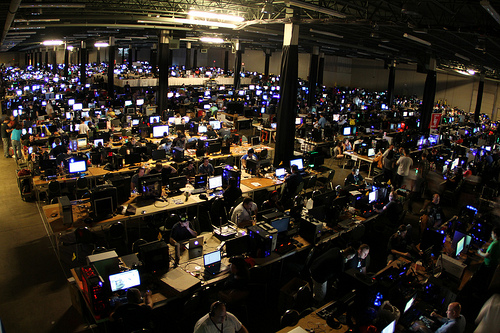


QuakeCon, the convention that never sleeps. (credit)

Swag

So how about the free stuff? Quakecon is always kind of exciting when it comes to swag. One minute you're playing video games and the next minute you’re part of a competition to win a free t-shirt, mouse, or whatever. The vendors also host competitions throughout the convention which result in some pretty sweet outcomes. One year I played in a Doom 3 competition and I won a $300 AMD processor by outfragging 2 other people and winning a raffle amongst 3 other “winners”. You never know when something is going to be given away at Quakecon and it’s another part of what keeps your rush constantly going.

The rush at BGG.con, on the other hand, hits you in stages. The first is when you walk into the main lobby with all the dexterity games. Register, take your badge, and immediately score 2-3 shrink wrapped games. I arrived on day 2 so the selection was reduced but I still made out with 2 pretty good games. Throughout every day there were scheduled drawings. Some were multiple game packages offered by the BGG staff and some were vendor related such as Thoughthammer’s game drawings. None of the 10 or so people I personally knew won anything, which was disappointing. On the other hand I’ll be making the trek up to Dallas many more times and when I win I hope it becomes as memorable as my $300 processor.

There’s a lot more money in video games and hardware than board games, and vendors love to show off at Quakecon. In 2009 there were couches set up for people to play games on DLP TV complete with full 3D technology thanks to NVIDIA. You will always find a good mix of both console and computer games out in the vendor area. Computers on steroids are set up to display gorgeous graphics and just watching modern technology in action is impressive. But the most noticeable eye candy are the models hired for the event. I imagine some of them get tired with the flirting and geeky ogles but most are good spirited. Games, girls, and gifts - these marketing pros know what their audience wants.

Vendor Booths

The BGG.con booths were smaller and partially manned by somebody high up on the publisher ladder such as Zev Shlasinger, owner of Z-Man Games, proudly displaying his company's recent and awesome additions to the board game market. There was no flash but you might be able to find a teacher for that game you've been eyeing for the past year. Fumbling over rules is one of the most difficult parts of the board gaming hobby. Having somebody sit down and explain how to play really sells the game to this market as much as anything does for video gamers.

Games, New and Old

It's no surprise that it's cheaper and easier to produce a board game than a video game. The result is that in a year when 10 great PC games hit the market, 50 great board games will too. While I can usually find a demo online to play a video game I'm interested in, it's not so easy to try out a board game. Because of that I felt like there was a lot less pressure to game at Quakecon. I always spent plenty of time in the vendor area, entering tournaments I couldn't win and generally just hanging out with people. At BGG.con, I really felt the need to cram in as many games as I could.

In a sense, a convention like BGG.con is a massive demoing of games. Board games are usually going to cost $30+ in addition to having to find people to play it. So whatever I don’t get to play at BGG.con I can only play if a friend or I just break down and purchase it. The double edged sword of board gaming is that old, good games still have a place in the hobby, meaning the number of games that are "in" keeps growing. By contrast, the number of multiplayer PC games is smaller as modern technology typically obsoletes older games. Although it's possible at QuakeCon to get in a game of a classic like Age of Empires II most of what you will find is limited to a couple dozen titles. To get a sense of how many games get played at BGG.con refer back to the games library link above.
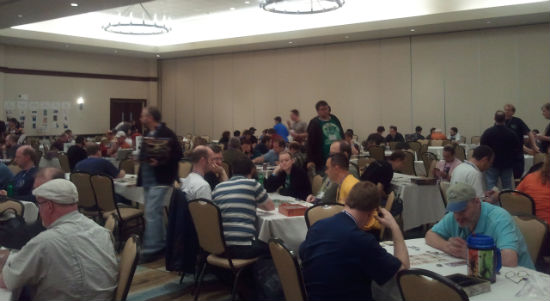


What do people play at BGG.con? EVERYTHING. (This is part of one of many rooms.)

Tournaments and Events

BGG.con offers one big tournament per day. Although I was too enamored by the sight of new-to-me cardboard to partake, they all seemed to be pretty successful. The poker tournament started with around 170 people, had no entry fee, and offered shrink wrapped games for the winners. I actually sat in the poker room for a while to play a game of Dungeon Lords because all of the other tables were in use. So even though I didn't get to play I can attest for a well run tournament. I can also attest that the speaker I foolishly sat right next to was working. Attendees also enjoyed a Tichu tournament (I need to learn that game) and a puzzle hunt (puzzle solving + scavenger hunt). According to some friends, the puzzle hunt had some weird scoring system but overall was a fun experience. These are all just diversions though with gamers playing for the sake of gaming. I daresay winning holds no meaning but it's pretty far from the list of objectives at BGG.con.

On the other hand, QuakeCon is a very competitive group! If there is something that can be turned into a competition, it is. Who can score the most frags on a gaming pro? Who has the coolest modded PC case? Even who has the most porn on their computer. Not everything is officially organized and gamers will often run their own tournaments and competitions. The only rule to follow is no entry charges, but you can usually count on some cool donations. Or at least donations consisting of free swag received from the day before.

QuakeCon is also known for the big money, sponsor endorsed, official tournaments. This year the game was Quake Live with 1v1 and capture the flag contestants playing for bragging rights and cash. Years past have seen id software showcasing their newest game and without any recent releases the easily accessible Quake Live was a good choice for this year's tournament crop.

All that being said, the coolest event at either con had to have been BGG.con's flea market. For one hour people basically host a giant, collective garage sale with things I actually want to buy. About 70 people can register to sell used games in the flea market and they get an hour before anyone else is allowed access. So the advantage to the sellers is they can buy some games early on with limited competition. The advantage to the buyers is that sellers really just want to get rid of these games. You can get some crazy deals during the final seconds of the flea market. One friend bought a $25 game, Roma, for only $2! It's fun working deals, it's fun seeing what's available, and it's one of the few times I have enjoyed shopping.

Closing Comments

There is no doubt that I will go back to both of these conventions many times throughout my life. I may outgrow QuakeCon because of the narrowly defined, younger age range but that's a ways further in the future than I typically think about. Even though I knew several people at both conventions there has been nobody else amongst my friends that have attended both. That may change in the future but I still don't expect much crossover.

The QuakeCon crowd is energetic, runs wild, and is enthralled by reflex based games. The BGG.con crowd is pensive, courteous, and enjoys careful dexterity games and interesting strategic decisions. Sure, there is some crossover in the game offerings but reflex based board games and multiplayer, turn based strategic video games are rare. Whether its sports, video games, or board games - I love games. I am happy to travel to Dallas for these good times and I'm happy there are good people at both stops to enjoy them with.

Monday, February 7, 2011

Guest post: Impressions of Witch's Brew...


"So I picked up Witch's Brew. I played it last December and was hooked right away.

It is short, at about half an hour a game, but the game still manages to offer a number of interesting choices along with the fun of saying such things as "NO! I'm the Witch" as a part of the actual game. It is also a very teachable game, with rules taking less than 15min. Oh, and best of all, it is fun even when you're not saying "I'm the Witch." And it seems to allow for people to play well without a deep understanding, making it a quick sell to new players, while at the same time offering enough depth for experienced players to make informed, interesting decisions that may not win them the game, but will leave them in good standing, making for high re-playability.

The bits are okay, though I wish they used wooden pieces for the gold and viles. Also, some of the important notation is subtler than it ought to be, and missing in one instance all together.

But overall, I would recommend this game to anyone who plays board games. The mechanics are simple and fun, while still offering some depth. The games are short, allowing you to play several games in a row or use it as a nice filler before playing a big sloggy game like Imperial. Personally, the problem with the bits and notation are easily over looked, and don't impact how good this game is." 

-Andrew Brown (Andrew organizes the weekly board game nights at the University of Waterloo, where he is an avid Go player currently working towards a PhD. in Mathematics.  He is also quite good at explaining the rules to complicated games in a simple way....  I think it's a math thing.)


Friday, September 3, 2010

Guest post: Dealing with the stigma...

Apparently my buddy Rami takes this blog much more seriously than me.  Here's another well-thought-out contribution: 

Rami here again. So this has been puzzling me for a long time: I unfortunately do not have the privilege of having a large group of personal friends who enjoy boardgaming. While trying to convert some, I noticed that there is often a huge stigma associated with boardgames. Either people think they are childish, are too difficult, or can in no way be fun. I try to get past this. Show them small little games at first, where skill could come a little later, and make them really simplistic and fun. With some this has worked, but others refused even this treatment.

When I ask people why they don’t want to play, I often get bland and uninformative answers. They rarely have a reason, or if they do have one, they rarely want to tell it to me. The weirdest thing is they will refuse a game and then go sit around and do nothing (it’s not that we alienate them, there’s a bunch of people not playing games around) – so it seems like they’d rather do nothing than try a boardgame. This just boggles my mind! How horribly do you have to see this game so that doing nothing at all looks good in comparison?

So I have this one friend that always refused to play any game. At one point I somehow managed to convince him to play one game of Coloretto – and he loved it! However, when a few days later I recommended another game, the stigma still stuck. He is now willing to play Coloretto if I bring out the game, but anything else gets an automatic 'No' without any consideration. So even though I showed him that these games are simple and fun, the stigma still persists.

What is it about games or maybe about us as players that make these games so… repulsive to other people? Why do these fears continue to exist even as boardgames are becoming more of a mainstream activity? How the hell do I get more of my friends to embrace boardgames?!?!

Rami is an occasional writer for DeathofMonopoly. If his commentary dazes, confuses, excites, intrigues, or congests you, then feel free to tell him about it by emailing him at rfinkelshtein@gmail.com

Thursday, August 26, 2010

Guest post: Ameritrash and Euros

Aha, the gauntlet has been taken up!  Here is my fellow gamer and buddy Rami, speaking in defense of Ameritrash games (see my previous post...):

Greetings everyone, I am the mysterious stranger that Eric has spoken of. You may call me Rami, or Excelcior the great, or maggot...I don't particularly care. I am a gamer. I almost want to say I am a "true" gamer yet no gamer can be more true than any other. I prefer to coin the term a 360° gamer. I will play anything at least once. Not just board games - anything. I am a continuing player of RPGs, computer games, and miniature games as well. I would even consider a LARP if I knew a group that was into it.

But enough about me. Lets talk about what Eric won't. Ameritrash! First of all let's establish that the name is not derogatory. It is just a name that stuck. Many people who enjoy the games speak the name with a level of respect, not to mention the term "Ameritrasher" sounds cool. For those not familiar, American games are generally ones with slightly more chaos and luck than the European (or German) games are known for. You have more fiddly bits, more dice, more player confrontation, and more chaos.

Let's start off by touching upon that last point since it often seems to be the largest complaint about many of these games. "This is too chaotic" people always say. While I have some similar sentiments to these groups, I personally find a majority of Euro games far too… well, orderly. That’s not necessarily a bad thing, but it seems that often in these games the conditions are far too ideal. This seems relatively strange considering how chaotic real life is. This is perhaps why we cling to the Euro games as the beacon of light. They are true order of a perfectly predictable world shaped only by our decisions. This is nice once in a while but also isn't it sometimes interesting to play in a slightly more realistic setting. Where you might not have full control of the situation but often each other person is in the same situation as you are. I guess what I'm trying to say is, chaotic is good as long as everyone is affected negatively equally.

I can go into more detail with the rest of the points but I can see this post is already getting long and rambling. Which means I have something to talk about in the next post at least.

So enjoy your gaming, and never be afraid of a little chaos.
Rami

Rami is apparently an occasional poster on Deathofmonopoly. If you have any topics to suggest, a score to settle, or wish to engage in a duel to the death you may reach him at rfinkelshtein@gmail.com.